



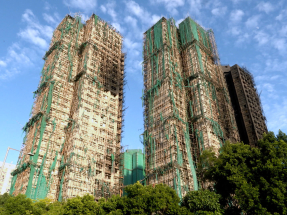
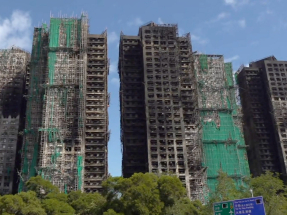
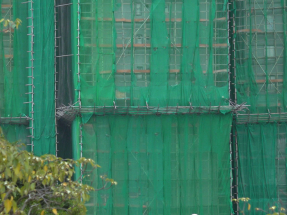
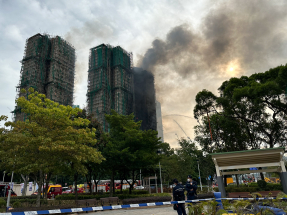
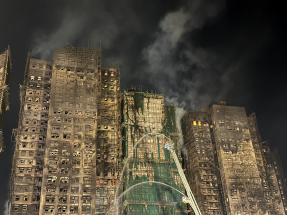
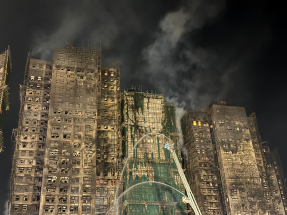
A fire engineering expert said the rapid vertical spread of the blaze at Wang Fuk Court last November was largely driven by scaffolding equipment, including safety nets and polystyrene foam, used during renovation work at the estate.
The testimony was delivered on the second day of the fifth round of evidentiary hearings before the independent committee investigating the deadly Tai Po fire.
Richard Yuen, chair professor of architectural engineering at City University of Hong Kong, told the committee that his team conducted full-scale fire tests at Sichuan University of Science and Engineering to determine whether scaffolding materials contributed to a secondary ignition effect.
The team constructed a three-storey mock-up of Wang Cheong House – the building where the fire originated – including the walls and windows of adjacent units, as well as combustible items that would normally be found in the units.
During the tests, the researchers compared four different types of scaffolding mesh: uncertified mesh, fire-retardant mesh, non-fire retardant mesh and samples taken from Wang Chi House, the only building not damaged by the fire.
Yuen highlighted one test in particular: when combining safety nets collected from Wang Chi House with non-fire retardant canvas, the result was a complete and total spread of fire across the entire scaffolding system.
He added that fire-retardant materials significantly reduced the severity and spread of fire.
In his written report, Yuen identified two key factors behind the blaze’s escalation: “the accumulation of combustible materials and the presence of suspected non-fire retardant materials in the re-entrant space".
He added that the build-up of combustibles provided the fuel, while non-fire retardant materials facilitated growth, ultimately allowing the fire to develop into a full-fledged and fast-moving inferno.
The academic also noted that weather conditions on the day played a role.
Dry air had reduced the moisture content in the scaffolding, making it more susceptible to ignition, and strong winds supplied additional oxygen and carried burning embers, further accelerating the fire’s spread, he said.
To Chi-wing, divisional commander (airport) for the Fire Services Department, took the stand next to explain the fire’s physical progression.
He testified that the intensity of the rapidly rising fire was strong enough to shatter windows, allowing flames to pour directly into the units.
He added the blaze also produced flaming droplets, wind-carried embers and falling debris, which together drove the massive spread to the other blocks.
According to To, the fire spread to around 300 flats in the first 30 minutes of the inferno.
When committee chairman David Lok asked whether the fire would have been halted and neighbouring Wang Tai House spared if Wang Cheong House had used compliant scaffolding nets, To responded that the conflagration would have been "much smaller" in scale.
_____________________________
Last updated: 2026-06-24 HKT 15:10
Edited by Edmond Fong
'Scaffolding materials fuelled rapid fire spread'
2026-06-24 HKT 13:48
Share this story


2026-08-12 HKT 15:20

2026-08-01 HKT 11:12
2026-07-30 HKT 13:59

2026-07-25 HKT 13:18

2026-07-21 HKT 15:31
2026-07-21 HKT 12:13

2026-07-19 HKT 14:27

2026-07-17 HKT 18:51
2026-07-17 HKT 17:19

2026-07-16 HKT 18:07

2026-07-15 HKT 22:07
2026-07-15 HKT 15:13
2026-06-30 HKT 13:46
2026-06-26 HKT 16:28

2026-06-25 HKT 15:28
2026-06-24 HKT 17:37
